


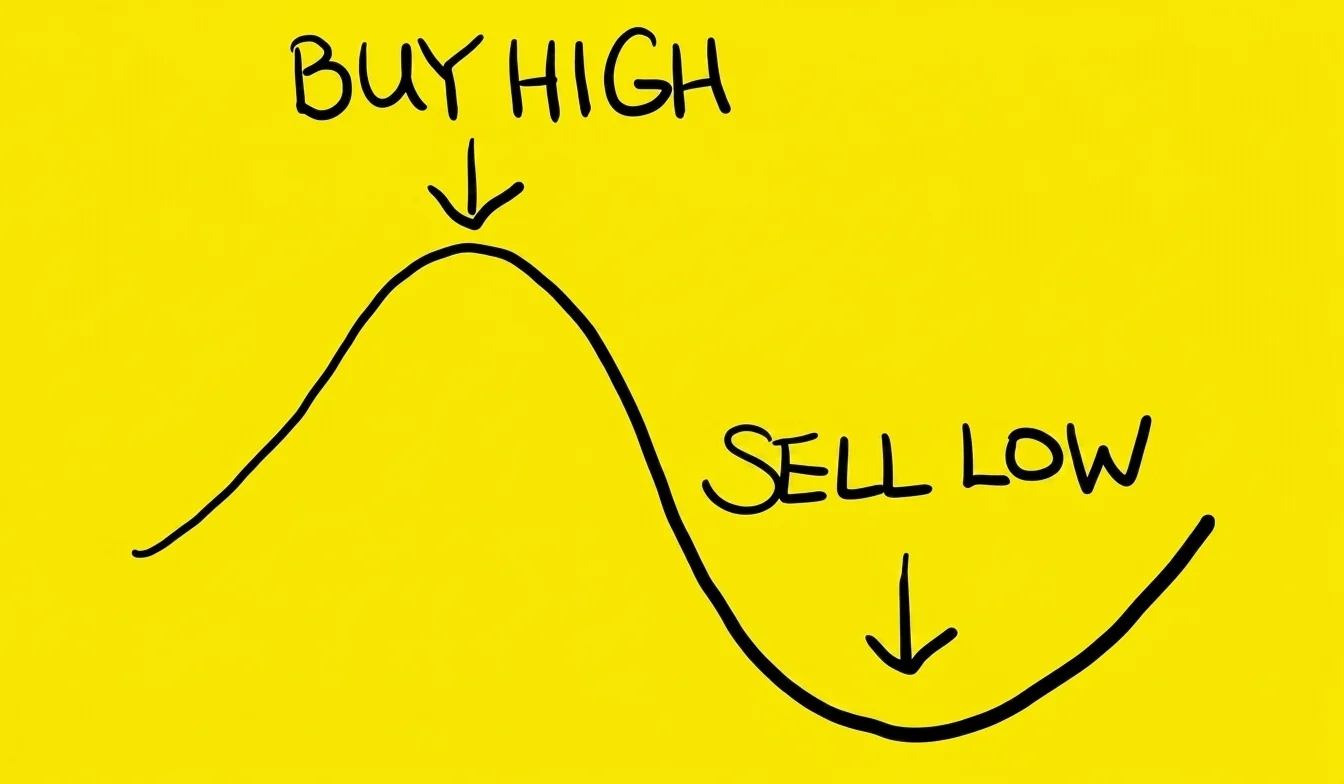
Every investor knows the golden rule: buy low, sell high. It is the absolute bedrock of wealth generation. Yet, if you look at actual retail investor capital flows, the reality is starkly inverted. The average investor consistently injects the most capital into the market right at the cyclical peak and panics out of positions right at the absolute bottom.
This happens because the human brain is fundamentally miswired for modern financial markets. For thousands of years, our evolutionary survival depended on herd behavior and immediate threat responses. If your tribe ran away from a rustling bush, you ran too. If everyone scrambled toward a fruit tree, you followed.
In a market environment, however, those exact same survival instincts are financial destruction. When an asset price plunges, your amygdala registers it as a physical threat, forcing an intense urge to capitulate and escape the pain. When an asset skyrockets, your social brain registers missing out as a loss of status, driving you to buy at any price. To survive the markets, you have to learn how to override your biology.
The Emotional Arc of a Market Cycle
The relationship between price movement and investor sentiment follows a highly predictable, repeating wave. What surprises many people is that the point of lowest actual risk rarely feels safe, and the point of highest risk feels entirely comfortable.
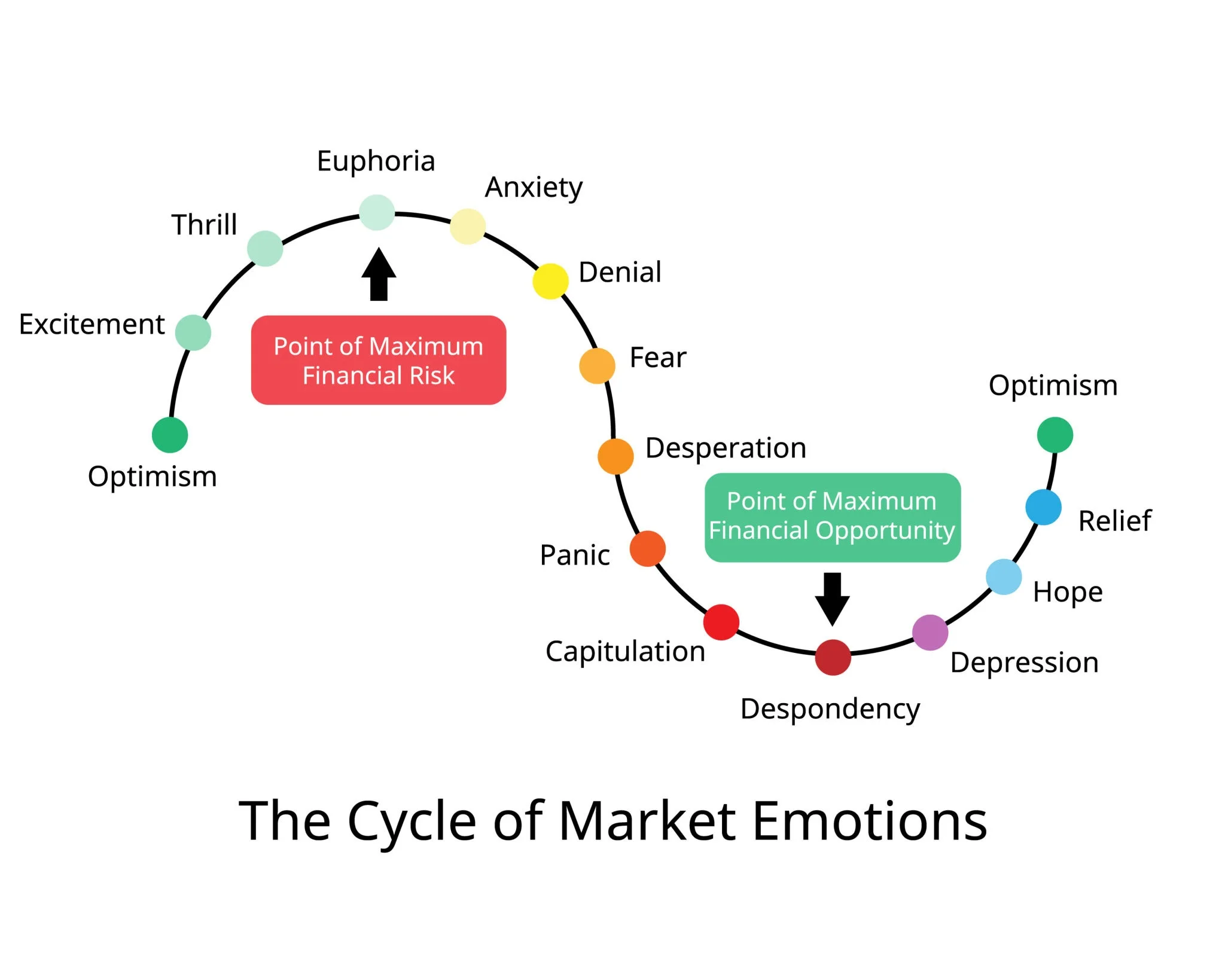
Take a close look at how sentiment shifts across this trajectory. At the peak of a bull market, when a stock or crypto asset has rallied hundreds of percent, the dominant emotion is Euphoria. This is what the chart correctly labels the Point of Maximum Financial Risk. Every headline is positive, your peers are making easy money, and buying feels completely natural. But because everyone who wanted to buy has likely already bought, there is no marginal capital left to push the price higher.
Conversely, look at the bottom of the curve: Capitulation and Despondency. Prices have collapsed, paper wealth has evaporated, and the media consensus is overwhelmingly bleak. This is the Point of Maximum Financial Opportunity. Yet, because the human brain heavily weighs recent events over historical averages—a flaw known as recency bias—buying here feels terrifying. Selling feels like the only way to protect what little capital remains.
Why Rational Thinkers Fall for the Trap
Even highly analytical investors get caught in this loop. Behavioral economists Daniel Kahneman and Amos Tversky proved this through their work on Prospect Theory, establishing a concept known as Loss Aversion.
Research shows that the psychological pain of a financial loss is roughly twice as powerful as the pleasure of an equivalent gain.
If you make $10,000, you feel a modest sense of satisfaction. If you lose $10,000, the resulting anxiety can completely derail your sleep, focus, and long-term planning. Because losses hurt twice as much, our primary psychological driver shifts from maximizing return to minimizing immediate pain.
This asymmetry creates a specific operational failure:
| Market Phase | Psychological Driver | Common Retail Action | Portfolio Impact |
| Parabolic Rally | FOMO & Social Proof | Buying the top with size | Maximizes downside exposure right before a reversal. |
| Minor Correction | Denial & Hope | Holding without a plan | Converts a temporary swing into an extended drawdown. |
| Deep Capitulation | Loss Aversion | Selling the bottom to “save capital” | Locks in paper losses permanently right before a macro recovery. |
A common mistake is assuming that you can simply “willpower” your way through these phases. You cannot. When a portfolio is down 40%, adrenaline and cortisol take over. If your strategy relies entirely on your emotional state in that moment, the market will break you.
Building a Systemized Defense
The only way to avoid buying high and selling low is to completely decouple your execution from your emotions. This requires shifting from a predictive mindset (“What do I think will happen next?”) to a systemic mindset (“What does my rule book tell me to do right now?”).
1. Establish Structural Rebalancing Rules
Instead of discretionary trading, utilize a fixed allocation framework. If your target portfolio is 60% equities and 40% bonds, a major market rally will naturally push your equity allocation up to perhaps 70%. Your system dictates an immediate, unemotional action: sell the outperforming asset (selling high) and buy the underperforming asset (buying low) to return to your 60/40 baseline.
2. Define Your “Invalidation Points” Before Entering
Never buy an asset without documenting exactly under what conditions you will exit. If you buy a stock because of its strong balance sheet and 15% year-over-year revenue growth, a 30% price drop without any change to the company’s underlying fundamentals is not a reason to sell. It is a structural buying opportunity. You should only cut the loss if the core thesis changes—for example, if the company takes on toxic debt or its market share permanently erodes.
3. Outsource Your Sentiment Tracking
Since our internal perception of market risk is flawed, we need objective, external data points to tell us when the crowd has reached an emotional extreme.
When the market is in extreme greed, it is a signal to tighten risk management, take profits, or stop adding new capital. When the market is in extreme fear, it is a signal to look for deep value.
The practical challenge is that when these extremes occur, we are usually entirely distracted by the narrative of the moment. To fix this, you can automate your awareness using tools like Fear Greed Live.
Turning Market Psychology into an Automated Alert
The core philosophy behind tracking crowd sentiment is simple: use the crowd’s emotional extremes as an operational indicator rather than a call to action.
Instead of constantly checking charts and letting your own anxiety build, a platform like Fear Greed Live monitors macro-level market sentiment for you. It functions as a programmatic circuit breaker. The platform tracks aggregate indicators of fear and greed and sends direct notifications to your preferred operational space before you make a reactive decision.
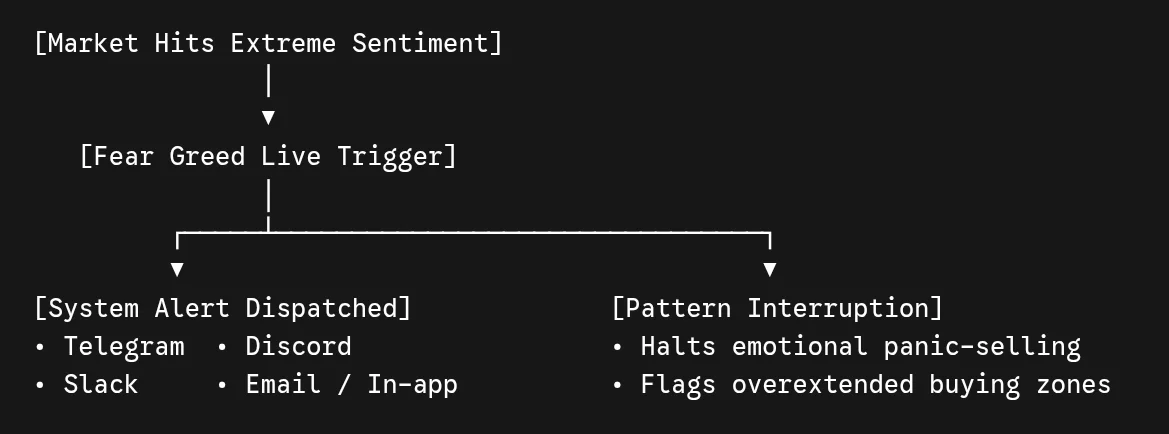
If the broader market begins to panic-sell into a cyclical bottom, you receive an instant alert on Slack, Discord, Telegram, or Email notifying you that market sentiment has hit extreme fear thresholds.
This notification acts as an immediate pattern interrupter. Instead of logging into your brokerage account to sell out of fear, the alert reminds you of where you are on the macro arc: you are sitting at the point of maximum financial opportunity. It shifts your focus back to your plan.
The Nuance: When Selling Low is Rational
To be clear, counter-cyclical investing is not a blanket recommendation to blindly buy every asset that is dropping or hold onto every failing investment forever. There is a distinct difference between a cyclical market correction and a structural failure.
If an individual growth stock or a speculative asset drops 80% because its business model has fractured, its management has failed, or its product has been rendered obsolete by new technology, holding on out of stubborness is just as dangerous as panic-selling an index fund at the bottom.
The rule of thumb is straightforward:
- Broad Indexes and Macro Assets: When diversified ETFs, major stock indexes, or foundational digital assets with deep liquidity drop significantly due to macroeconomic fears (such as interest rate hikes, geopolitical tension, or general inflation concerns), the drop is almost always structural market noise. These are the situations where you must resist the urge to sell low and instead look to accumulate.
- Idiosyncratic Assets: When an individual asset drops independently of the broader market due to internal failure, the thesis is broken. Cutting your losses early—even if it means selling lower than your entry—is a disciplined risk-management protocol, not an emotional capitulation.
The investors who survive multiple market cycles are those who understand that prices follow sentiment, and sentiment is cyclical. By building structural rules, ignoring short-term media narratives, and setting up automated alerts to track macro sentiment objectively, you stop running with the herd and start operating like an institutional market participant.